%20(1).png)
AI-Assisted Delivery
The Challenge
Vehicle delivery asks a lot of a sales associate at once.
Educating a new owner, demonstrating features, completing required tasks, and documenting what was covered all compete for attention during an important moment in the ownership journey.
I was brought into the broader delivery experience project to concept three moments where AI could meaningfully support the dealer and owner.
Educating a new owner, demonstrating features, completing required tasks, and documenting what was covered all compete for attention during an important moment in the ownership journey.
I was brought into the broader delivery experience project to concept three moments where AI could meaningfully support the dealer and owner.
Role
AI Experience Designer
timeline
1 Week
Scope
Human + AI interaction design
AI-accelerated prototyping
THE VISION
A high-touch moment that should stay human.
Rather than introducing another interface demanding attention, we envisioned AI as an ambient copilot that could capture context, understand what was happening, surface assistance when useful, and preserve what was learned.
AI could observe and recommend. People would remain in control.

.png)
Let AI handle the complexity so people can stay present.
Use AI to understand context, reduce administrative work, and surface what matters without taking control away from the dealer.
THE APPROACH
Expanding the solution space
Starting with personas, journey stages, and experience goals from the strategy team, I used AI to rapidly explore different interpretations of the same experience.
I intentionally left out the existing UI and design system to keep the exploration open.
Same inputs. No predetermined design direction.
I intentionally left out the existing UI and design system to keep the exploration open.
Same inputs. No predetermined design direction.
AI EXPLORATION
INPUTS
Starting with strategy
Personas, journey stages, and experience goals from the strategy team grounded the exploration in real customer and business needs.
.png)
PROMPT SYNTHESIS
Creating a shared brief
I used ChatGPT to turn the strategy inputs into one consistent prompt for each generative design tool.
One brief. Multiple interpretations.
One brief. Multiple interpretations.
.png)
V0 by vercel
From plan to prototype
V0 proposed an experience plan before building, giving me a checkpoint to review or redirect the approach.
Once approved, it quickly translated the brief into a clickable prototype.
AI proposed. I approved. Then it built.
Once approved, it quickly translated the brief into a clickable prototype.
AI proposed. I approved. Then it built.
.png)
Google STITCH
Expanding across the journey
Stitch interpreted the same brief more broadly, connecting associate and owner experiences across pre-delivery, handoff, and post-delivery.
It pushed beyond a single workflow into a more complete cross-device ecosystem.
Same brief. Broader system.
It pushed beyond a single workflow into a more complete cross-device ecosystem.
Same brief. Broader system.
.png)
.png)
LOVABLE
Choosing a direction
Lovable generated multiple experience directions before building, creating a clear decision point in the process.
I selected the direction I wanted to pursue, but the build stopped when the available credits ran out.
AI explored. I chose. Tool limits shaped what came next.
I selected the direction I wanted to pursue, but the build stopped when the available credits ran out.
AI explored. I chose. Tool limits shaped what came next.
.png)
Starting with strategy
Personas, journey stages, and experience goals from the strategy team grounded the exploration in real customer and business needs.
INPUTS
Creating a shared brief
I used ChatGPT to turn the strategy inputs into one consistent prompt for each generative design tool.
One brief. Multiple interpretations.
One brief. Multiple interpretations.
PROMPT SYNTHESIS
From plan to prototype
V0 proposed an experience plan before building, giving me a checkpoint to review or redirect the approach.
Once approved, it quickly translated the brief into a clickable prototype.
AI proposed. I approved. Then it built.
Once approved, it quickly translated the brief into a clickable prototype.
AI proposed. I approved. Then it built.
V0 by vercel
Expanding across the journey
Stitch interpreted the same brief more broadly, connecting associate and owner experiences across pre-delivery, handoff, and post-delivery.
It pushed beyond a single workflow into a more complete cross-device ecosystem.
Same brief. Broader system.
It pushed beyond a single workflow into a more complete cross-device ecosystem.
Same brief. Broader system.
Google STITCH
Choosing a direction
Lovable generated multiple experience directions before building, creating a clear decision point in the process.
I selected the direction I wanted to pursue, but the build stopped when the available credits ran out.
AI explored. I chose. Tool limits shaped what came next.
I selected the direction I wanted to pursue, but the build stopped when the available credits ran out.
AI explored. I chose. Tool limits shaped what came next.
LOVABLE
Beyond the generated output
The most useful inspiration wasn’t the interfaces AI produced. It was seeing when the tools automated the work and when they invited me back into the process.
When should AI act, and when should a human step in?
When should AI act, and when should a human step in?
DESIGN REFLECTION
Grounding the concept in reality
The AI model still had to work within an established delivery process. Existing checklist requirements and completion records created clear guardrails for where intelligence could assist without disrupting the workflow.
The goal was to augment the experience, not redesign the process around AI.
The goal was to augment the experience, not redesign the process around AI.
design CONSTRAINTS
DELIVERY CHECKLIST
Defining what must happen
The existing checklist established the required tasks and completion states the AI-assisted experience needed to preserve.
.png)
DELIVERY SUMMARY
Defining what carries forward
The existing summary established how completed delivery activities were documented and carried into the post-delivery experience.
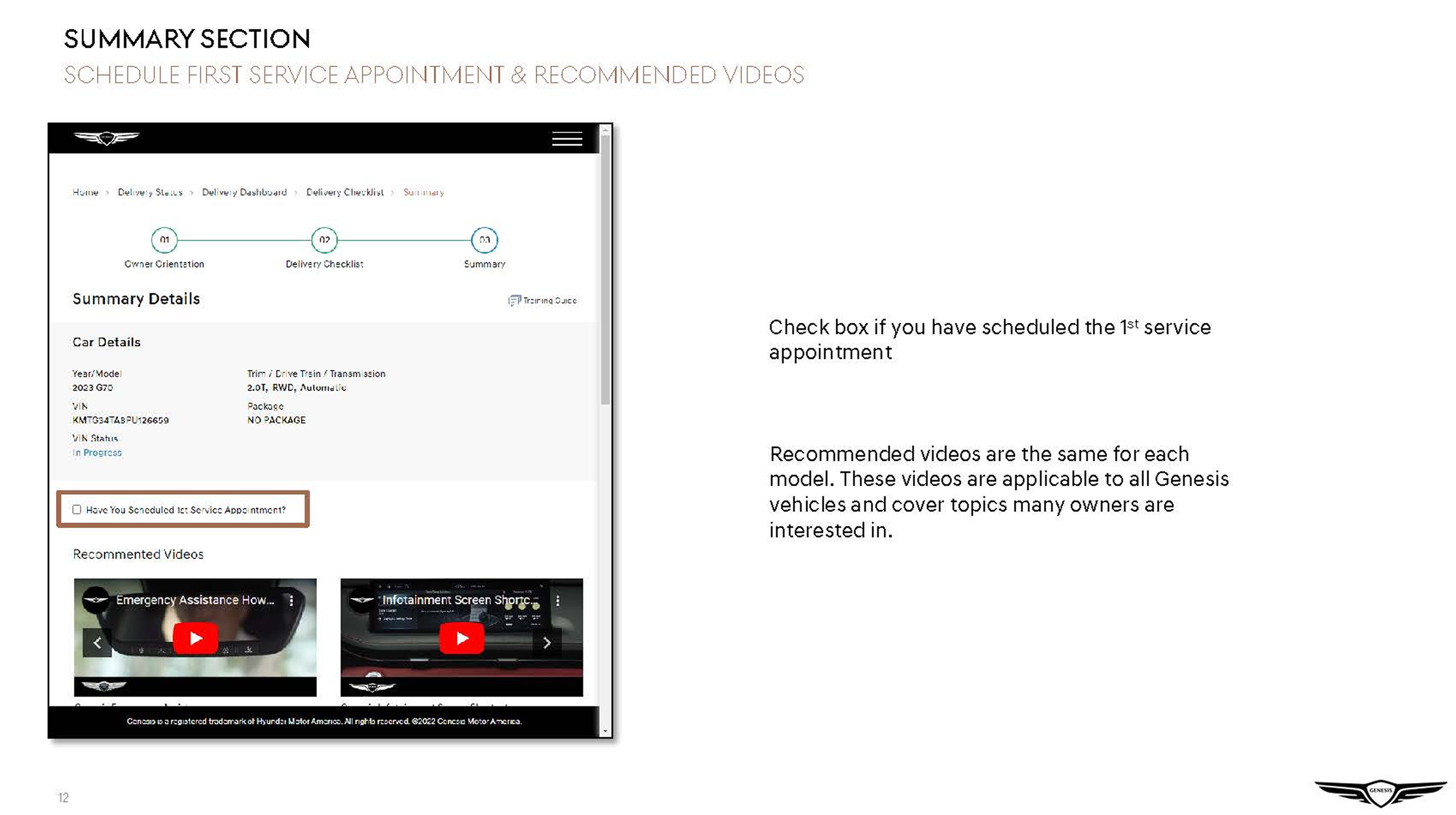
Listening beyond the checklist
A traditional workflow could track required tasks. AI could interpret the conversation around them, connecting what was discussed back to the delivery experience.
The value wasn't automating the checklist. It was understanding what happened between the clicks.
The value wasn't automating the checklist. It was understanding what happened between the clicks.
WHY AI
Modeling where AI acts and people step in
The next question was how AI should participate without taking control.
I mapped the experience across pre-delivery, handoff, and post-delivery to define where AI could assist, where human judgment was needed, and what should carry forward.
AI could do more of the work without taking over the relationship.
I mapped the experience across pre-delivery, handoff, and post-delivery to define where AI could assist, where human judgment was needed, and what should carry forward.
AI could do more of the work without taking over the relationship.
FUNCTIONAL MODEL
.png)
Human-designed foundation. AI-assisted interaction.
I designed three connected moments within the existing design system and dealer workflow, so the AI layer felt like a natural extension of the experience rather than a separate tool.
Once the core UI was in place, I used ChatGPT to translate the interaction logic into prompts for Figma AI, then brought the strongest microinteractions back into the final designs.
Once the core UI was in place, I used ChatGPT to translate the interaction logic into prompts for Figma AI, then brought the strongest microinteractions back into the final designs.
EXPERIENCE DESIGN
Listening while the dealer leads.
AI uses existing owner and vehicle context to help prioritize the walkthrough, then continues listening as the dealer works through orientation.
The dealer stays focused on the owner while context builds quietly in the background.
The dealer stays focused on the owner while context builds quietly in the background.
AMBIENT INTELLIGENCE
.png)
Surfacing what matters next.
As the conversation evolves, AI can surface relevant features, content, and follow-up needs without forcing the dealer through a predetermined sequence.
Assistance adapts to the conversation, not the other way around.
Assistance adapts to the conversation, not the other way around.
LIVE HANDOFF
.png)
Carrying the conversation forward.
Confirmed session context becomes a personalized recap the owner can listen to, revisit, and use to continue learning after delivery.
The conversation doesn't end with the handoff.
The conversation doesn't end with the handoff.
POST-DELIVERY
.png)
More attention on the owner. Less on the process.
The final experience used AI to personalize the walkthrough, track what was covered, and reduce the administrative burden on the dealer, while giving the owner a more useful path from delivery through continued learning.
%20(1).png)
Back Top

© 2026 LauraLau.Design